Summary:
A broken AC anywhere else is an inconvenience. In Clark County, NV, it’s a different situation entirely. When temperatures push past 110°F and stay there for days, a system that goes down isn’t just uncomfortable — it can be dangerous, especially for kids, elderly family members, and pets.
The problem is that most AC repair information online wasn’t written with Clark County in mind. The desert creates failure patterns that don’t show up in other markets, and the decisions you make — repair or replace, who to call, how much to spend — matter more here than almost anywhere else. Here’s what you actually need to know.
Home AC Repair in Clark County: Why the Desert Changes Everything
Most residential AC systems in the U.S. are designed to handle a few months of heavy use each year. In Clark County, your system runs in cooling mode for roughly eight to nine months straight. That’s not seasonal wear — that’s sustained, year-round stress that shortens the average system lifespan from the national 15–20 years down to closer to 12–15 years here.
Add in Mojave Desert dust clogging condenser coils, hard water mineral buildup in condensate lines, and the UV radiation beating down on rooftop package units — a housing feature common across Henderson, Summerlin, and North Las Vegas — and you’ve got a set of failure conditions that are genuinely unique to this region. A technician who’s only worked in moderate climates won’t recognize these patterns as quickly as someone who’s been servicing Clark County systems for years.
Central Air Conditioner Repair: The Most Common Failures in Clark County Homes
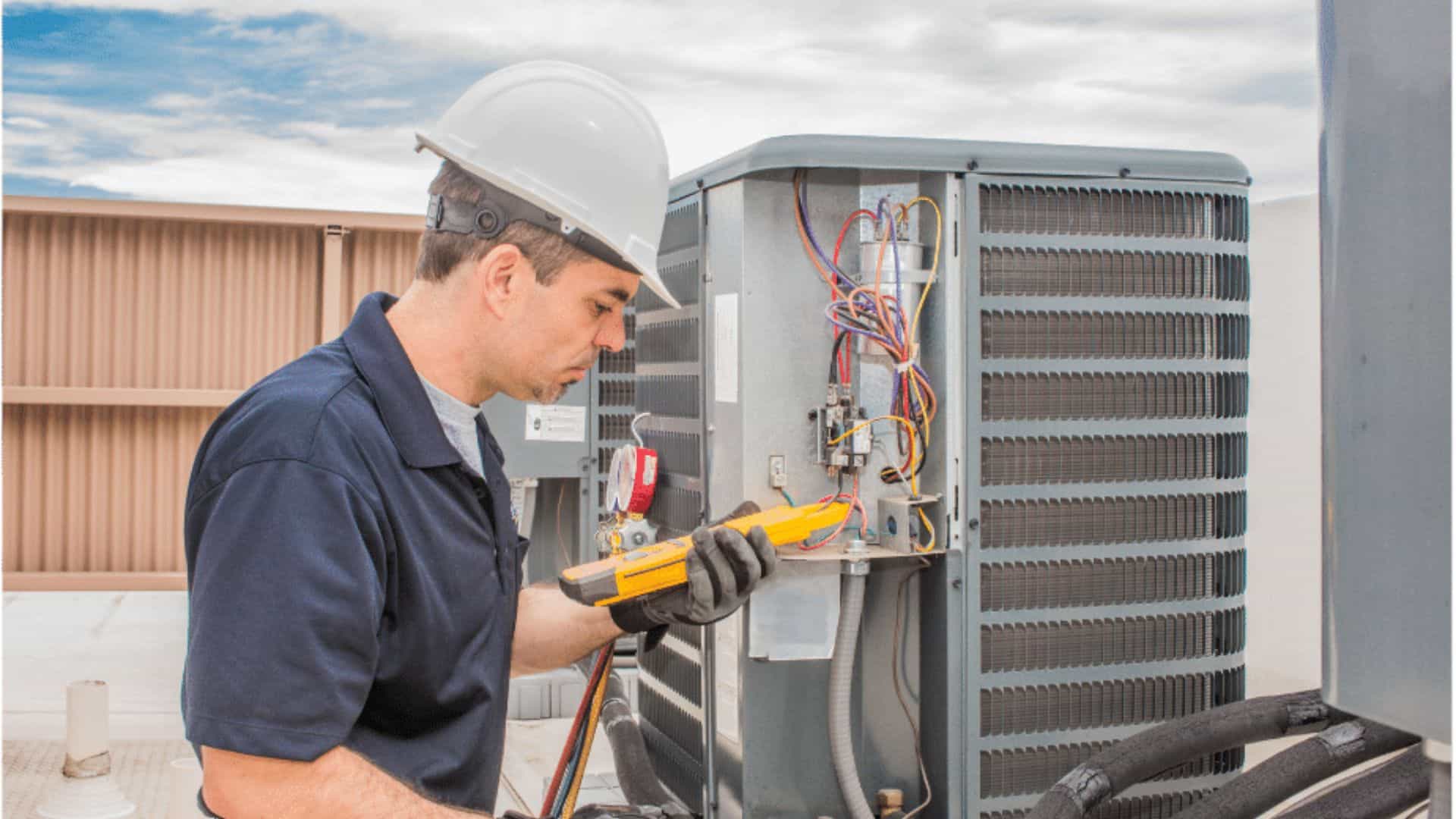
The number one AC repair in Clark County isn’t dramatic — it’s a capacitor. These small electrical components are responsible for starting and running the compressor and fan motors, and they’re highly vulnerable to sustained heat. When rooftop package units sit in direct sun all summer, the surface temperature around them can exceed 160°F. Capacitors simply weren’t built to handle that indefinitely, which is why they’re the single most common repair call in this market.
After capacitors, the next most frequent issues are refrigerant leaks, contactor failures, and dirty or fouled condenser coils. A coil caked in desert dust can’t release heat efficiently, which forces the compressor to work harder and eventually fail. That’s a $2,100–$5,200 repair — and it’s almost always preventable with regular coil cleaning.
One thing worth understanding: if your AC is blowing warm air, low refrigerant is often the first assumption. But refrigerant doesn’t get consumed like fuel. If your system is low, there’s a leak somewhere. Recharging without finding and fixing that leak is a temporary fix that will fail again, and refrigerant costs have risen significantly in recent years. A proper repair addresses the source, not just the symptom.
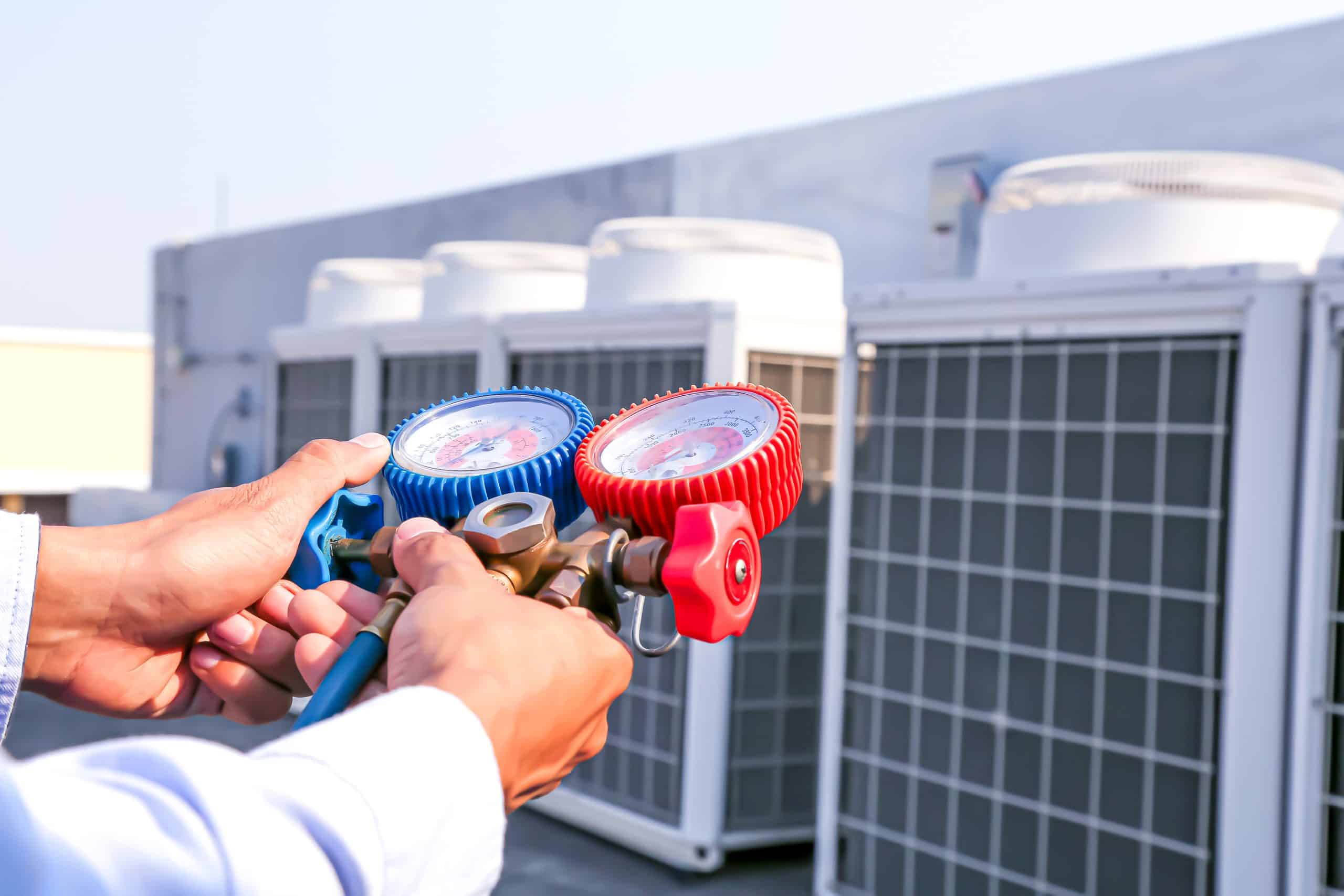
The diagnostic process matters more than most people realize. A technician who goes straight to adding refrigerant without running a pressure test or leak check isn’t doing you a service. What you want is someone who identifies the actual root cause before touching anything — because the wrong repair on an aging system can cost you more than the system is worth.
Heat and Air Conditioning Repair: Don't Forget the Winter Side
Clark County winters don’t get the attention they deserve. Most people outside the area assume it’s warm year-round, but our winters regularly drop below freezing between November and February. That means your HVAC system isn’t just a cooling machine — it’s a year-round life-safety system, and the heating side deserves the same attention as the AC.
Furnace failures in January aren’t as dangerous as AC failures in July, but they’re not trivial either. A home that drops to 45°F overnight is a real problem for families, elderly residents, and anyone with health conditions. The most common heating failures in this market are ignitor failures, heat exchanger cracks, and blower motor issues — none of which are visible to a homeowner without proper diagnostic equipment.
The other thing worth knowing is that Las Vegas HVAC systems work both sides harder than systems in most other cities. Your equipment doesn’t get a real off-season. It transitions from months of heavy cooling to months of heating with very little rest in between. That continuous operation accelerates wear on components that might last 15 years in a milder climate but show failure signs at 8 or 10 years here. Scheduling a check before each season — not just when something breaks — is genuinely worth it in this market.
HVAC System Repair Costs in Clark County: What to Actually Expect
One of the most common complaints about HVAC contractors — and you’ve probably heard this from a neighbor — is that the price quoted on the phone doesn’t match what ends up on the invoice. It’s a real problem in this industry, and it’s made worse by the fact that most homeowners don’t have a reference point for what things should cost.
Understanding the general cost landscape before you call anyone puts you in a much better position. You don’t need to become an HVAC expert, but knowing that a capacitor replacement is a $150–$400 repair — not a $1,200 emergency — means you won’t be caught off guard.

AC Repair Cost: What Common Repairs Run in Clark County
For most single-visit AC repairs in Clark County, you’re looking at a total cost somewhere between $250 and $900, with the majority of jobs landing in the $450–$650 range. That includes the diagnostic fee, labor, and parts. Diagnostic fees alone typically run $75–$150, and we apply that toward the repair if you move forward.
Capacitor replacement is on the lower end — usually $150–$400 all in. Refrigerant leak repair varies widely depending on where the leak is and how accessible it is, but expect $200–$1,500 depending on complexity. Evaporator coil replacement averages around $1,500, ranging from $700 to $1,800. A compressor replacement is the big one: $2,100–$5,200, which is why it often triggers a serious conversation about whether repair still makes sense.
Emergency and after-hours calls add $50–$150 on top of standard rates, which is worth knowing before you call at midnight in July. That premium is reasonable given the circumstances, but it’s not something you want to discover after the fact.
If you’re looking at a new system entirely, air conditioner installation in Clark County typically runs $6,500–$8,500 for most residential homes, depending on system size and configuration. NV Energy’s PowerShift rebate program can offset $340–$3,400 of that cost for qualifying homeowners — a Nevada-specific incentive that’s worth asking about before you sign anything.
This is the question most homeowners dread, partly because it involves real money and partly because they’re usually being asked to decide it while standing in a hot house with a contractor they just met. Here’s a framework that takes the pressure off.
A widely used rule of thumb is the $5,000 rule: multiply the age of your system in years by the estimated repair cost. If the result exceeds $5,000, replacement is generally the more cost-effective path. A 12-year-old unit facing a $500 capacitor repair scores $6,000 — that’s borderline. The same unit facing a $1,800 evaporator coil replacement scores $21,600 — replacement almost certainly makes more sense. It’s not a perfect formula, but it gives you a starting point that isn’t just a contractor’s opinion.
The 30% rule is another useful check: if the repair cost exceeds 30% of what a new system would cost, you’re often better off putting that money toward replacement. On a $7,500 system, that threshold is $2,250. Anything above that deserves a serious conversation about replacement.
In Clark County specifically, the shortened system lifespan matters here. A unit that’s 10 years old in our market has experienced the equivalent of 15+ years of moderate-climate use. Major component failures on a system that age — compressor, evaporator coil, heat exchanger — are often a signal that other components are close behind. Replacing one expensive part only to face another expensive repair six months later is a frustrating and costly pattern.
The right answer depends on your specific system, its condition, and your budget. Financing options exist for homeowners who need a new system but can’t absorb the full cost upfront — and that’s worth knowing before you default to a repair that may not hold.
Local AC Repair Service in Clark County, NV
The HVAC market in Clark County is crowded, and most companies say roughly the same things about themselves. What actually separates a good contractor from a frustrating one is simpler than the marketing suggests: we show up when we say we will, we tell you what’s wrong before we charge you for it, and the price on the invoice matches the price we quoted.
If your system is struggling — or already down — the worst thing you can do is wait. In a Las Vegas summer, indoor temperatures can become dangerous within hours of an AC failure. Same-day service and 24-hour availability aren’t just conveniences in this market; they’re the baseline expectation.
We’ve been servicing homes and businesses across Clark County since 2007 — from Summerlin and Spring Valley to Henderson and North Las Vegas. If you want a straight answer about what’s wrong with your system and what it will cost to fix it, that’s exactly what we’re here for.